Zakaria Khan
In 1721, Zakariya Khan was appointed governor of Lahore by the Mughal court and embarked on a campaign to eradicate the Sikhs. In 1739, hundred of Sikhs were rounded-up and executed at Lahore at a horse-market that later became known as Shahidganj. Furthermore, anyone caught helping Sikhs would be punished and those who cut the hair of Sikhs, provided a Sikh head, or gave intel on Sikhs were rewarded. In 1745, Zakaria Khan sent a force to Phula village to arrest Bhai Taru Singh, as he had been providing assistance to Sikhs. Bhai Taru Singh was subsequently executed at Lahore.
Yahya Khan
During the Chhota Ghallughara of 1746, the Sikh inhabitants of Lahore were first rounded up, then executed on 10 March 1746. Hundreds of Sikhs living in Lahore were rounded up and executed. The captives from the group of Sikhs that had been originally encamped in the Kahnuwan jungle but later captured while attempting to escape were marched back to Lahore, paraded in the streets and publicly beheaded. For months, they were held and paraded atop of donkeys in Lahore. The captured Sikhs were ultimately killed specifically at Nakhas Chowk in Lahore. The heads of thousands of Sikhs were carried on carts and hung at the gates of Lahore as trophies. Minarets were constructed out of piles of dismembered Sikh heads and their decapitated and mangled bodies were buried within the walls of a mosque.
Shah Nawaz and Mir Mannu
The Mughals officially restarted their anti-Sikh campaign with the appointment of Shah Nawaz as subahdar in 1747. Mir Mannu established a building resembling a mosque at the site where muftis (Muslim judges) would give captives the join between conversion to Islam or execution. Between 1748–53, Mir Mannu had conducted his own persecution of the Sikhs and captured five-hundred Sikhs at Ram Rauni through the assistance of Adina Beg. These Sikhs were tortured and executed at the place now known as Shahidganj in Lahore on the occasion of Eid.
Punjabi historian Ganesh Das makes note of the site of being where many Sikhs were executed:
Large numbers of them (i.e. Sikhs) were shot down, while many others were brought in chains to Lahore where they were executed at a place near the Nakhas outside the Delhi gate, which afterwards came to be called Shahid GanjSikh women and children were kept in jails at the site, with them being forced to grind wheat and made to starve. The sons of the women were beheaded and their remains thrown into seven nearby wells. According to Sikhs, Sikhs captured by the Pahari Rajas were brought to Lahore, where Mir Mannu beginning in 1748 would tortured and executed them. The torturers would throw Sikh babies in the air and catch them on their spears. Sikh mothers of slain children would have pieces of their murdered children places around their neck as a garland by their captors. Diwan Kaura Mal requested the Sikhs to assist Mir Mannu during the Battle of Multan, therefore he gave the Sikhs control over the site in-response. The Sikhs then built a shrine at the site.
Recent history
In 1935, a new gurdwara building replaced the old one. A well and kothri were located at the premises. After partition in 1947, the gurdwara became controlled by the Evacuee Trust Property Board. The gurdwara is one of the few Sikh temples still in operation as their original function in Pakistan.
Location
The shrine is located in Naulakha Bazaar at the coordinates 31°34'42.8"N 74°19'55.4"E.
Architecture
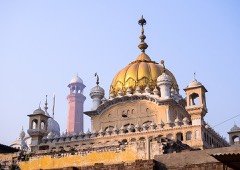
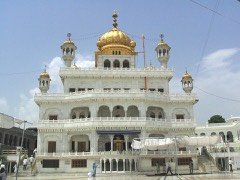
The structure is made out of marble and combines old and new styles. A portico is situated on a podium in the centre of the site. The interior of the site is embellished. The remains of holding cells and student quarters can be found at the site.